> ## Documentation Index
> Fetch the complete documentation index at: https://luarmor.mintlify.site/llms.txt
> Use this file to discover all available pages before exploring further.
# Optimising your script
Luarmor uses [Luraph™️](https://luraph.com) as the obfuscation provider. So if you're experiencing lags, fps drops, or even crashes, you must use certain `macros` in your script. This documentation will show you everything about the `LPH_NO_VIRTUALIZE` macro
## Why does obfuscation affect performance?
Because [Luraph™️](https://luraph.com) is a VM based obfuscater that generates its own instructions that are interpreted by Luraph, which, in turn, is interpreted by the Lua interpreter. So the number of instruction cycles increases exponentially.
Normally, your script gets compiled into a set of Lua instructions. See the example below:
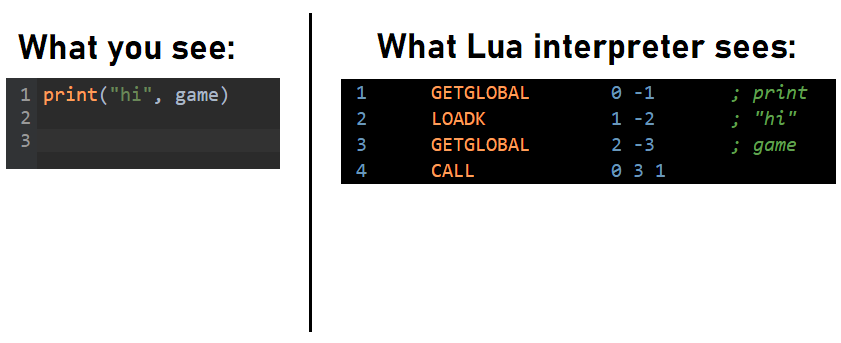 As you can see, your simple "print" statement gets compiled into 4 instructions. Each instruction is a cycle, so it will take **4 cycles to execute your code**.
When you obfuscate your script, the main goal is to make the original code unreadable. Luraph does this by generating its custom instruction set that can be understood by Luraph VM only.
See the example below:
As you can see, your simple "print" statement gets compiled into 4 instructions. Each instruction is a cycle, so it will take **4 cycles to execute your code**.
When you obfuscate your script, the main goal is to make the original code unreadable. Luraph does this by generating its custom instruction set that can be understood by Luraph VM only.
See the example below:
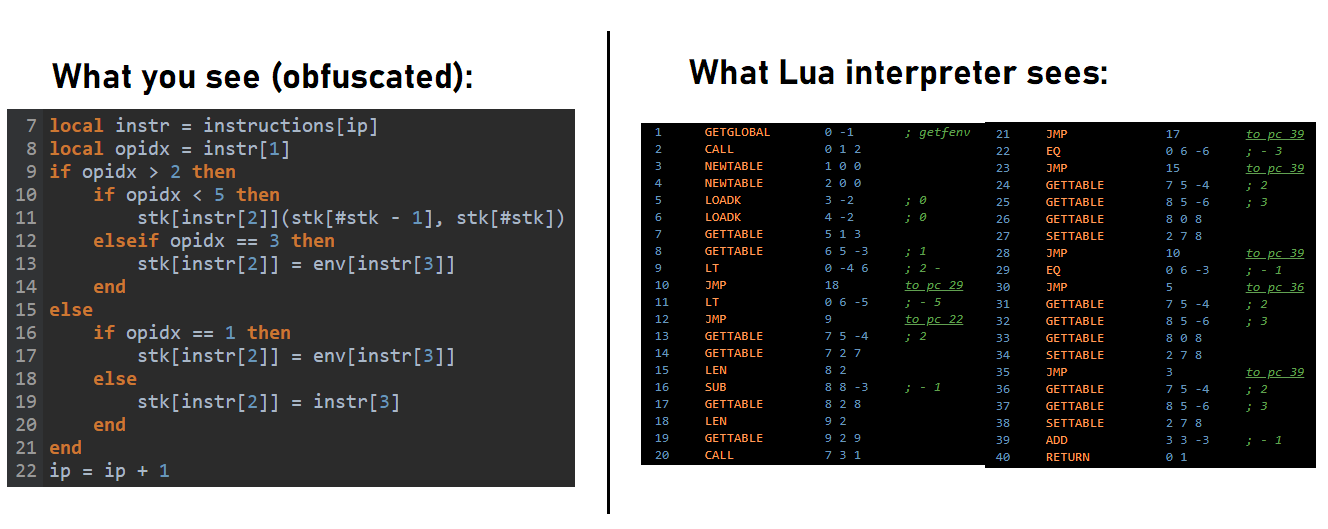 Notice how your simple print statement turned into 40 instructions, which will take **40 cycles to execute**. Also keep in mind that Luraph does a lot of things to obfuscate the code flow, which will ultimately lead to *even more instructions*.
Normally, Lua is extremely fast, therefore you **will not notice** any performance impact. But when your code runs **hundreds of times per second**, there will be obvious lags, fps drops, or even freezes during the execution of the instructions above.
A good example would be RenderStepped connections. At this point, everyone knows that you love wrapping your wallhack render function inside this **RenderStepped** event.
Notice how your simple print statement turned into 40 instructions, which will take **40 cycles to execute**. Also keep in mind that Luraph does a lot of things to obfuscate the code flow, which will ultimately lead to *even more instructions*.
Normally, Lua is extremely fast, therefore you **will not notice** any performance impact. But when your code runs **hundreds of times per second**, there will be obvious lags, fps drops, or even freezes during the execution of the instructions above.
A good example would be RenderStepped connections. At this point, everyone knows that you love wrapping your wallhack render function inside this **RenderStepped** event.
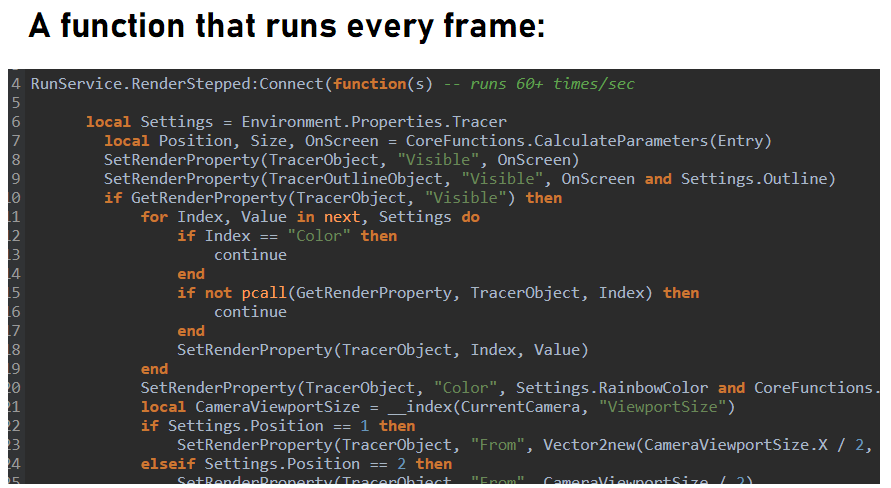 This code will be slow when obfuscated. Because the number of instructions generated by Luraph will be more than *2000*. This means Lua will have to run **2000+ instruction cycles** **every** frame. Which will be around **60 \* 2000 = 120k** instructions to run every second.
And there are local functions (e.g. `CalculateParameters`) used in this loop, which automatically means that function will be executed as well, which will lead to *even more and more instructions to run*.
Here is a second example. A metamethod hook on `__index`:
This code will be slow when obfuscated. Because the number of instructions generated by Luraph will be more than *2000*. This means Lua will have to run **2000+ instruction cycles** **every** frame. Which will be around **60 \* 2000 = 120k** instructions to run every second.
And there are local functions (e.g. `CalculateParameters`) used in this loop, which automatically means that function will be executed as well, which will lead to *even more and more instructions to run*.
Here is a second example. A metamethod hook on `__index`:
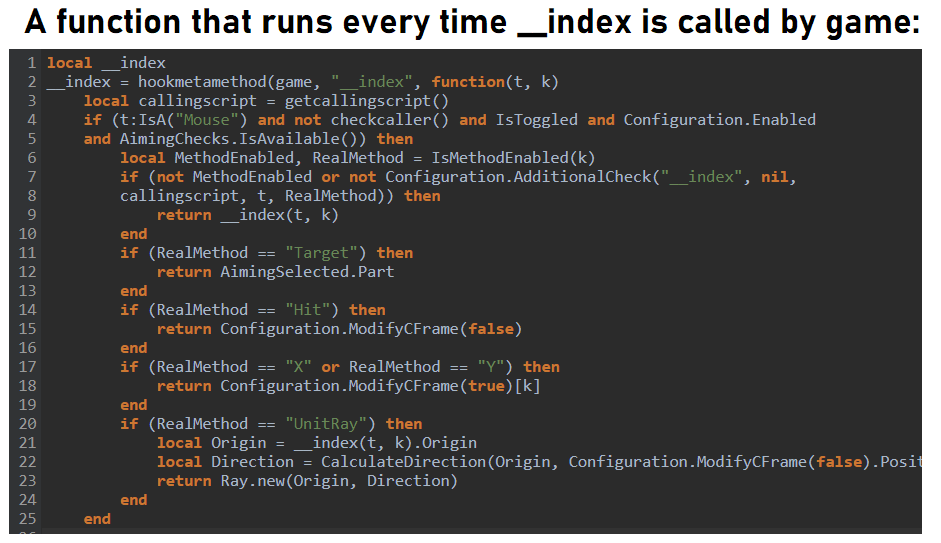 `__index` runs quite often. Example:
* `game.Workspace`,
* `game.Players...`
* etc...
These will invoke the `__index` function and run the code above. This will be extremely resource intensive and heavy, considering that it is probably called **thousands of times per second**.
And on top of that, **if you obfuscate this part**, you will end up with **more than a million** instructions to run every second, which will crash your game.
## How to deal with this problem?
**Do not** wrap your entire script in LPH\_NO\_VIRTUALIZE as it defeats the purpose of virtualization (obfuscation). Only use this macro if a function runs more than 30 times per second.
You have to exclude these chunks from obfuscation. You can either use `loadstring()`, or `LPH_NO_VIRTUALIZE`.
It is recommended to use `LPH_NO_VIRTUALIZE` instead of loadstring while excluding chunks from obfuscation, because it is generally harder to view the code when you're using `LPH_NO_VIRTUALIZE`.
## How to use `LPH_NO_VIRTUALIZE`?
`LPH_NO_VIRTUALIZE` takes one constant argument which must be a function, and returns a function that can be called.
**It is important** to add this on top of your script, so you won't have issues while running the original code.
```lua theme={null}
getfenv().LPH_NO_VIRTUALIZE = function(f) return f end;
```
You will find some examples below on how to properly use `LPH_NO_VIRTUALIZE`:
```lua theme={null}
RunService.RenderStepped(LPH_NO_VIRTUALIZE(function(s)
-- regular function body
end))
```
```lua theme={null}
old = hookmetamethod(game, "__index", LPH_NO_VIRTUALIZE(function(t, k)
-- regular function body
end))
```
```lua theme={null}
local generateTracers = LPH_NO_VIRTUALIZE(function(pos, pos2)
-- function body
end)
RunService.Heartbeat:Connect(generateTracers)
```
```lua theme={null}
LPH_NO_VIRTUALIZE(function()
for i,v in pairs(getgc()) do
if type(v) == 'table' then
f = v
end
end
end)()
```
```lua theme={null}
local function doSomething()
-- function body
end
LPH_NO_VIRTUALIZE(doSomething) -- you can't pass reference arguments
hookfunction(print, doSomething)
```
```lua theme={null}
LPH_NO_VIRTUALIZE( -- this is a syntax error
local old old = hookmetamethod(game, "__namecall", function(...) end)
)
```
```lua theme={null}
LPH_NO_VIRTUALIZE(function()
-- something
end) -- This part will not run because you are not calling it at the end.
-- You should add an extra () at the end in order to call it
print('done')
```
## Where to use `LPH_NO_VIRTUALIZE`?
* `RenderStepped` connections
* `Heartbeat` connections
* `__index` metamethod hooks
* `__namecall` metamethod hooks (optional)
* `while true` loops with no delay
* GC scan loops
* `function`s, if they are called by one of those above
`__index` runs quite often. Example:
* `game.Workspace`,
* `game.Players...`
* etc...
These will invoke the `__index` function and run the code above. This will be extremely resource intensive and heavy, considering that it is probably called **thousands of times per second**.
And on top of that, **if you obfuscate this part**, you will end up with **more than a million** instructions to run every second, which will crash your game.
## How to deal with this problem?
**Do not** wrap your entire script in LPH\_NO\_VIRTUALIZE as it defeats the purpose of virtualization (obfuscation). Only use this macro if a function runs more than 30 times per second.
You have to exclude these chunks from obfuscation. You can either use `loadstring()`, or `LPH_NO_VIRTUALIZE`.
It is recommended to use `LPH_NO_VIRTUALIZE` instead of loadstring while excluding chunks from obfuscation, because it is generally harder to view the code when you're using `LPH_NO_VIRTUALIZE`.
## How to use `LPH_NO_VIRTUALIZE`?
`LPH_NO_VIRTUALIZE` takes one constant argument which must be a function, and returns a function that can be called.
**It is important** to add this on top of your script, so you won't have issues while running the original code.
```lua theme={null}
getfenv().LPH_NO_VIRTUALIZE = function(f) return f end;
```
You will find some examples below on how to properly use `LPH_NO_VIRTUALIZE`:
```lua theme={null}
RunService.RenderStepped(LPH_NO_VIRTUALIZE(function(s)
-- regular function body
end))
```
```lua theme={null}
old = hookmetamethod(game, "__index", LPH_NO_VIRTUALIZE(function(t, k)
-- regular function body
end))
```
```lua theme={null}
local generateTracers = LPH_NO_VIRTUALIZE(function(pos, pos2)
-- function body
end)
RunService.Heartbeat:Connect(generateTracers)
```
```lua theme={null}
LPH_NO_VIRTUALIZE(function()
for i,v in pairs(getgc()) do
if type(v) == 'table' then
f = v
end
end
end)()
```
```lua theme={null}
local function doSomething()
-- function body
end
LPH_NO_VIRTUALIZE(doSomething) -- you can't pass reference arguments
hookfunction(print, doSomething)
```
```lua theme={null}
LPH_NO_VIRTUALIZE( -- this is a syntax error
local old old = hookmetamethod(game, "__namecall", function(...) end)
)
```
```lua theme={null}
LPH_NO_VIRTUALIZE(function()
-- something
end) -- This part will not run because you are not calling it at the end.
-- You should add an extra () at the end in order to call it
print('done')
```
## Where to use `LPH_NO_VIRTUALIZE`?
* `RenderStepped` connections
* `Heartbeat` connections
* `__index` metamethod hooks
* `__namecall` metamethod hooks (optional)
* `while true` loops with no delay
* GC scan loops
* `function`s, if they are called by one of those above